
Stop Losing Deals to Your Own WMS
Love Your WMS Again or Break up. Don’t Settle.
Insights from MODEX 2026 for multi-client 3PLs who know something is off but can’t quite name it.
Your WMS Isn’t Broken and That’s Exactly the Problem
If you’re a multi-client 3PL managing anywhere from five to fifty or more customer relationships, this is probably familiar: the system runs. Shipments go out. Customers are mostly happy. Your team has figured it out.
But onboarding takes longer than it used to. Changes that once took a day now take a week. Growth feels heavier, not lighter. And in some cases, opportunities get harder to say yes to because your system can’t support them fast enough. Every new customer adds a layer of coordination your WMS wasn’t quite designed to handle, and your team absorbs it.
“It worked great when we had 10 customers. Now we have 60.”
We heard some version of that sentence more than once at MODEX 2026. From 3PLs running anywhere from a few sites to dozens, stable, profitable businesses that were growing steadily but increasingly strained by it.
Nobody said their WMS was broken. They said they were “doing more with it now.” They said they’d “figured out workarounds.” They said things were “manageable.”
That word, manageable, is where the problem hides. If your operation is genuinely growing, why is everything getting harder instead of easier?
What We Heard at MODEX: Complexity Is Breaking the Model
What MODEX 2026 Confirmed:
- Complexity is outpacing the systems most 3PLs built their operations on.
- Operators aren’t looking for more technology. They’re looking for systems that reduce effort, not add it.
- The gap between stable and scalable has never been wider.
Complexity breaking the model wasn’t a startup problem. We heard it from experienced operators who had grown steadily for years until the system that once fit the business started shaping it instead. They didn’t make a mistake. They hit a structural ceiling.
- More customers means more requirements, more variability, and more places for things to slip.
- Onboarding new clients takes longer than it should and often requires workarounds the system was never built for.
- Integrations stall. Billing becomes harder to reconcile at scale. Teams quietly fall back on spreadsheets to fill the gaps.
- The WMS doesn’t fail overnight. It becomes the constraint gradually, one workaround at a time.
“Has your WMS kept up with you or are you working around it?” Most operators knew the answer before they finished the sentence.
Across MODEX conversations, from booth meetings to our panel Q&A, different operators, different WMS platforms, same pattern: the system wasn’t failing. It just wasn’t keeping up.
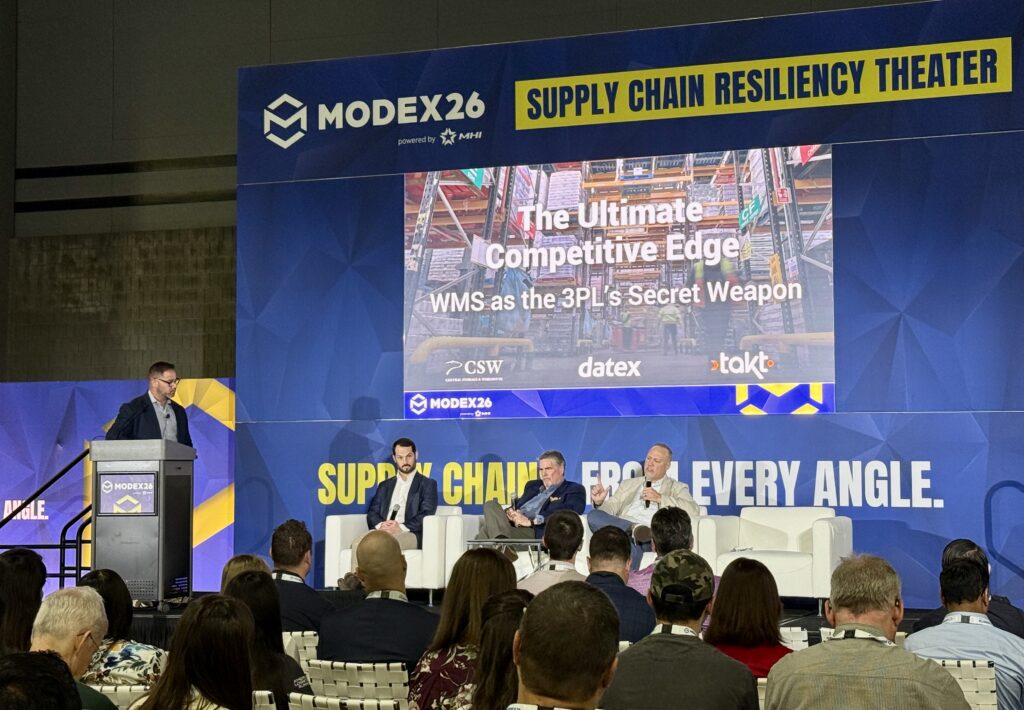
Want the full conversation? Watch our MODEX panel.
The AI Conversation Is Missing the Point
AI was everywhere at MODEX 2026. Agentic workflows. LLM-driven decisions. Predictive labor.
No one’s questioning the potential. The gap is practical. What operators are really asking is:
- Does it work in my operation on a Tuesday afternoon when something goes wrong?
- Can my team trust the output?
- Does it reduce effort, or does it just add another dashboard to ignore?
“We can’t even trust our inventory data. How would AI improve that?”
That’s not resistance to technology. That’s a reasonable question that most AI pitches don’t answer.
The real conversations at MODEX weren’t about AI. They were about system integration, data quality, and execution reliability. AI came later, if at all.
AI Won’t Fix a Broken Operation
The failure pattern isn’t mysterious. Poor data leads to unreliable outputs. Disconnected systems mean no real visibility. Rigid workflows mean nowhere to execute. Put those three together and the most sophisticated AI model in the world can’t help you.
Here’s a simpler way to say it: If your operation isn’t working cleanly today, AI won’t fix it. It will expose it.
“Predictive labor sounds great, until your item master isn’t consistent across customers.”
That’s not an edge case. That’s most warehouses. If your WMS is held together by workarounds and your data isn’t structured, AI will surface the inconsistencies faster, not fix them.
Most warehouse AI initiatives struggle in their first year because the underlying systems and data structures can’t support them, regardless of how well the models perform.
The Real Bottleneck: Your WMS Is the Foundation
“A modern WMS is a growth platform that determines integration speed, onboarding capacity, and operational scalability, not just a system that tracks inventory.”
Your WMS determines how fast you can onboard new customers, what you can integrate, and how far you can scale. It is either an enabler or a constraint. There is no neutral.
The Three Paths 3PLs Take and Why Two of Them Have a Ceiling
When operators realize their WMS is becoming a constraint, they typically take one of three paths:
Path 1:
Keep Patching
- Workarounds compound over time
- Teams absorb the friction invisibly
- Growth continues, but slower
Path 2:
Replace at the Ceiling
- Painful, expensive, high disruption
- Often forced by crisis, not strategy, and with a risk of landing in the same position again
- Risk of repeating the same problem
Path 3:
Build on a Platform
- System evolves with the business
- Configuration, not crisis, drives change
- Growth accelerates instead of straining
The question facing most growing 3PLs is no longer “extend or replace.” It’s “can your platform evolve with you?” because a system that can’t is a ceiling with a countdown.
What “Evolving Your WMS” Actually Looks Like
The outcomes come first: faster customer onboarding, workflows that adapt without IT tickets, integrations that don’t stall, customer-specific requirements handled in days instead of weeks.
But the economic argument is what moves budget conversations:
- “This directly impacts how fast you can bring on revenue.”
- “This reduces the cost of supporting each new customer.”
- “Every week a new customer sits in onboarding is a week of margin you’re not capturing.”
“A new customer with custom labeling requirements and a non-standard billing structure turns into a 3-week onboarding process. Your ops team builds workarounds. Your billing team reconciles manually. That’s not a customer problem, that’s a platform problem.”
This is what low-code application platforms make possible and why operators who adopt them move faster than those who don’t. Faster time-to-revenue per customer. Lower cost-to-serve at scale.
“This doesn’t mean giving operations full control over the system. It means reducing the number of changes that require a development queue.”
Your IT team doesn’t disappear. Governance doesn’t go away. What changes is the category of work that requires them. Configuration that took three weeks gets done in three hours.
“A low-code WMS platform is a warehouse management system that allows operations teams to configure workflows, integrations, and customer requirements without heavy development dependency, reducing the gap between a business need and the system catching up to it.”
Reality Check: Where Does Your WMS Actually Stand?
Most 3PLs know something is off. Fewer can name exactly where. These questions help locate it.
Growth Friction
- Do new customers take significantly longer to onboard than they did two years ago?
- Are customer-specific requirements handled through workarounds rather than system configuration?
- Is your team absorbing complexity that your WMS should be handling?
Data Friction
- Do you rely on spreadsheets for billing, reporting, or reconciliation?
- Is your inventory data consistent and trustworthy enough to act on in real time?
- Would you be confident putting your current data in front of an AI system?
Change Friction
- Do small operational changes require IT involvement or development time?
- Do integrations with new tools or partners take longer than expected?
- Are there things your team has stopped asking for because they know the system can’t do it?
Stable
System works. Team has adapted. Growth is manageable but slower than it should be.
Straining
Onboarding takes too long. Spreadsheets fill gaps. Small changes require too much effort.
Blocked
New customers stall. Integrations fail. The WMS is visibly the ceiling on growth.
Most 3PLs answer yes to one or two. The warning sign is when it’s four or five, especially if they’re spread across all three categories. That means the friction isn’t isolated. It’s systemic.
Normalized friction is still friction. It’s just friction you’ve stopped noticing.
You Should Be Able to Fall in Love With Your WMS Again
Most companies tolerate their WMS. They’ve stopped expecting it to be good and quietly built their operation around its limits instead of demanding more from it.
That’s the wrong way to think about a system that determines how fast you grow, how profitably you operate, and how confidently you walk into a new customer relationship.
Don’t settle for “manageable”
Don’t settle for workarounds, delays, or systems your team has to compensate for every day.
The goal isn’t to survive your WMS. It’s to have a system that makes your team’s work easier, not harder. Onboarding that doesn’t require heroics. Changes that don’t require tickets. A platform that keeps up with your team instead of the other way around.
Asking more from your WMS leads to one of two outcomes: you unlock more value from what you already have, or you realize it can’t get you there. Either answer moves you forward.
Settling doesn’t.
One Question That Defines Your Next Move
“Can your WMS support where your business is going, not just where it is today?”
That question sat at the center of the best conversations we had at MODEX 2026. It’s where AI readiness starts. It’s where growth strategy actually begins. It’s where differentiation gets decided.
The winners in this market won’t be the most stable. They’ll be the most adaptable.
You already know whether you love your WMS, or you’re just used to it.

Frequently Asked 3PL WMS Questions
What are signs your WMS is outdated?
Slower customer onboarding, reliance on manual spreadsheets, integration delays, and small operational changes that require significant IT effort are the most common indicators. The subtler sign: your team has stopped asking for things because they already know the system can’t deliver them.
Why do 3PLs outgrow their WMS faster than other warehouses?
Because 3PLs aren’t managing one operation. They’re managing dozens simultaneously, each with its own workflows, billing structures, and integration requirements. A single-client warehouse configures its system once and optimizes from there. A 3PL re-configures for every new customer. Add the pace of onboarding and offboarding, and the result is a system under constant pressure to adapt. Most WMS platforms were built for stability, not variability. That’s not an operational failure. It’s structural complexity.
When should a 3PL replace their WMS?
When extending the current system costs more — in time, money, and team effort — than moving to a platform built for growth. The tipping point is usually visible in onboarding timelines, integration delays, and the number of manual workarounds a team maintains without acknowledging them as a problem.
What is the difference between a WMS upgrade and a WMS platform?
A WMS upgrade adds features to an existing system. A WMS platform provides a configurable foundation that evolves with the business — including workflow flexibility, integration capacity, and low-code customization without a development queue for every change.
Can AI improve warehouse operations?
Yes — but only when data is structured and systems are connected. AI amplifies what’s already working. It cannot compensate for poor data quality or disconnected workflows. The question to ask before any AI investment: is my WMS ready to support it?
What is a low-code WMS?
A warehouse management system that allows operations teams to configure workflows, billing rules, and integrations without requiring software development for each change. It reduces the gap between a business need and the system catching up to it.
Ready to Find Out Where You Stand?
Three ways to take the next step, starting with whatever feels most relevant right now:
- See if your WMS is helping you grow or costing you growth. Use the Stable / Straining / Blocked framework above to locate the friction in your operation.
- See how other 3PLs are rethinking their WMS after MODEX. Connect with our team to hear what operators at similar scale are prioritizing right now.
- Get a free preview of Footprint WMS. A low-commitment way to stay close to the conversation and get a free preview, no call required.