
Omnichannel Retail Fulfillment from One WMS
Retail 3PL Warehouse Management Software
Unify DTC, wholesale, and retail fulfillment in a secure, scalable WMS built to handle complexity, adapt quickly, and protect your clients’ brand standards.
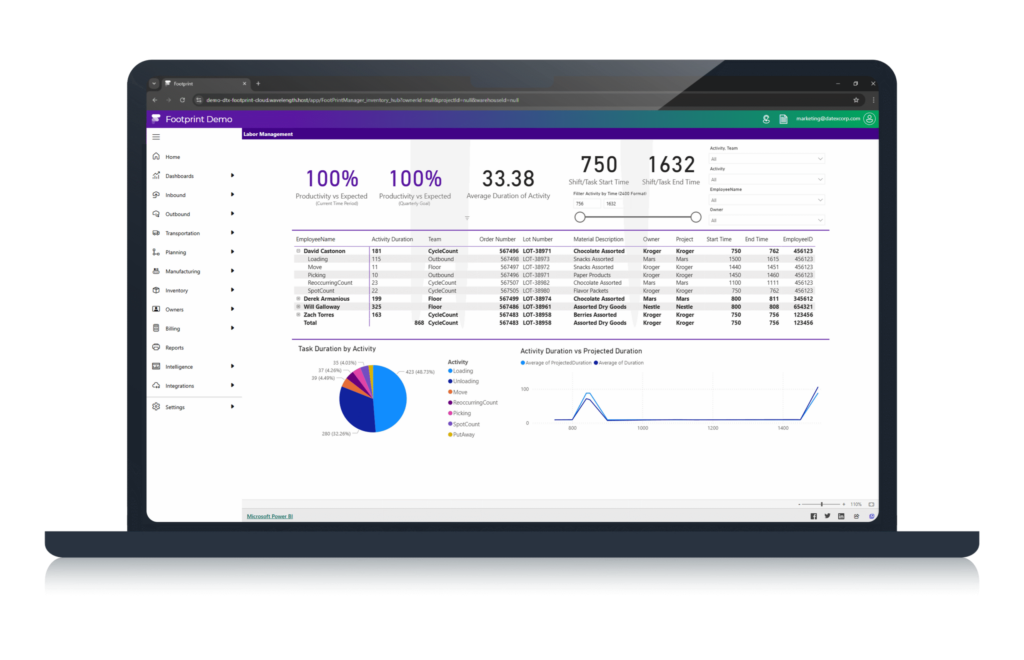
What Retail 3PLs Need From a WMS
Whether managing inbound, outbound, or returns, your customers expect fast, accurate, and consistent service. Datex Footprint WMS adapts to shifting volumes, brand requirements, and unique workflows for every retail channel.
Retail Compliance & Routing Guide Support
Automate routing guides with labels, ASNs and EDI to meet client requirements.
DTC, Wholesale & Retail Fulfillment
Pick, pack, and ship bulk and DTC orders from one workflow.
Seamless Third-Party Integrations
Onboard faster with prebuilt EDI, marketplace, and shipping channel integrations.
SLA Performance Tracking
Monitor and enforce order accuracy, ship speed, and delivery commitments.
Landon Edwards / FFE Solutions Group
Managing Partner
Today we’re shipping thousands of orders per day. We have a pretty sophisticated process in the warehouse where we utilize cartonization heavily. This enables us to really tailor to the needs of our individual clients.
Footprint WMS is a system that has definitely been a key part of our success and our growth.
Scale Retail Ops Without Slowing Down
Footprint WMS combines deep 3PL retail expertise with powerful retail fulfillment capabilities in a cloud-native system, so you get faster onboarding, effortless routing guide compliance, customer-specific billing, and brand-tailored workflows without relying on traditional custom development. Plus, with built-in support for AMRs, ASRS, and smart conveyors, it’s automation-ready when you are.
Retail 3PL Fulfillment Capabilities
Omnichannel Retail Fulfillment
- Support pre-built workflows for eCommerce and DTC fulfillment, B2B, dropship, and replenishment in one system.
- Track orders and inventory across fulfillment channels.
- Connect with Amazon, Shopify, Magento, ShipStation, and other platforms.
Returns and Reverse Logistics
- Track SKU-level return trends in real time.
- Automate disposition rules, grading, and put-away.
- Apply customer- or product-specific rules for return processing.
Retail Compliance and Visibility
- Support UCC-128, GS1, ASNs, EDI, and customer-specific labeling requirements.
- Maintain auditability and user-level access controls.
- Manage role-based permissions and multi-tenant governance.
Zebra Hardware
Need hardware for your operation? Datex partners with Zebra to deliver hardware that actually holds up, on the floor, in the aisle, and when operations are under pressure.

Frequently Asked Questions
About Retail 3PL WMS
How can a WMS handle B2B and DTC orders in the same warehouse?
A WMS can support B2B and DTC fulfillment in the same operation by applying different allocation, picking, packing, labeling, and replenishment rules based on order type and customer requirements. Footprint WMS supports B2B and DTC/eCommerce fulfillment within one system, with configurable wave templates and allocation rules by customer, order class, carrier, or service level. Inventory can be shared or segregated by channel based on how the operation is configured.
What is cartonization in a 3PL WMS?
Cartonization is the process of determining how orders should be packed into cartons based on factors such as item dimensions, weight, and available carton types. In Footprint WMS, cartonization can run within wave allocation using configurable carton types with weight and cube requirements, and the same logic can also support pallet building. Carrier labeling is typically handled through integrated third-party shipping solutions.
Can a WMS integrate with warehouse automation such as AMRs, ASRS, and conveyors?
Yes. A WMS can integrate with warehouse automation such as AMRs, ASRS, conveyors, and other material handling systems to coordinate inventory and warehouse execution. Footprint WMS supports automation integration through APIs, database triggers, file transfers, and MHE/WCS/WES integrations. Specific integration requirements depend on the automation equipment and the operation’s existing controller logic.
What is a retail 3PL WMS?
A retail 3PL WMS is warehouse management software designed for third-party logistics providers that manage high-velocity retail and eCommerce fulfillment for multiple clients. It supports multi-client inventory, DTC and wholesale fulfillment, integrations, billing, and customer-specific workflows within one system.
How does a retail 3PL WMS support customer-specific billing?
A retail 3PL WMS can connect warehouse activity to customer-specific billing rules so billable services are captured as work occurs. Footprint WMS supports complex 3PL billing and contract-aligned reporting to help reduce missed charges and manual reconciliation.
How does a retail 3PL WMS support retailer compliance?
A retail 3PL WMS can help manage customer-specific routing guides, EDI transactions, ASNs, labeling, and exception workflows within warehouse operations. Footprint WMS supports configurable requirements by retail trading partner so 3PLs can manage different compliance needs within the same system.
How does a WMS support omnichannel retail fulfillment?
A WMS can coordinate inventory and order execution across multiple sales channels without requiring separate systems. Footprint WMS uses configurable allocation, waving, replenishment, and integrations to support DTC, wholesale, marketplace, and store-replenishment workflows within one platform.
How does a retail 3PL WMS support returns and reverse logistics?
A retail 3PL WMS can support returns through structured receiving, disposition workflows, inventory holds, put-away rules, and traceability. Footprint WMS keeps returns within the same warehouse system used for inbound and outbound operations, helping 3PLs maintain control across multiple retail clients.
What should a retail 3PL look for in a WMS, and what questions should it ask vendors?
A retail 3PL should look for a WMS that supports multi-client inventory, omnichannel fulfillment, retailer compliance, integrations, returns, customer-specific workflows and billing, and growth across facilities and channels. Ask vendors how they structure the solutioning phase, what user acceptance testing requires from your team, whether their implementation timeline accounts for your operational complexity, and what happens to costs and support if the schedule shifts. Also ask how the system handles different client requirements, DTC and wholesale workflows, EDI and routing guides, customer-specific billing, integrations, and ongoing operational changes.
Implementation timelines vary depending on the number of facilities, integrations, customer requirements, and overall operational complexity. Datex follows a structured implementation methodology with defined phases and sprint-based delivery, guiding teams from planning and configuration through testing, go-live, and transition to support.
The goal is to minimize disruption while helping your operation realize value as quickly as possible.