
Inbound Logistics recently published its 2026 3PL Perspectives Report, the 21st edition of its annual research examining the priorities, challenges, and technology investments shaping the third-party logistics (3PL) industry. Datex supported this year’s research as a sponsor, helping bring these industry insights to logistics leaders.
Rather than summarize the report, which we encourage every logistics leader to read in full, we’d like to explore what several of its findings mean for warehouse operators and the technology decisions many 3PLs are making today.
The report doesn’t prescribe technology decisions, but it does highlight the operational priorities and challenges shaping the industry. Viewed through that lens, several clear implications emerge for organizations evaluating warehouse technology.
Growth Is Increasing Operational Complexity
One of the report’s clearest findings is the strength of growth across the 3PL market. Eighty-four percent of surveyed providers reported sales growth, while 77% added new customers.
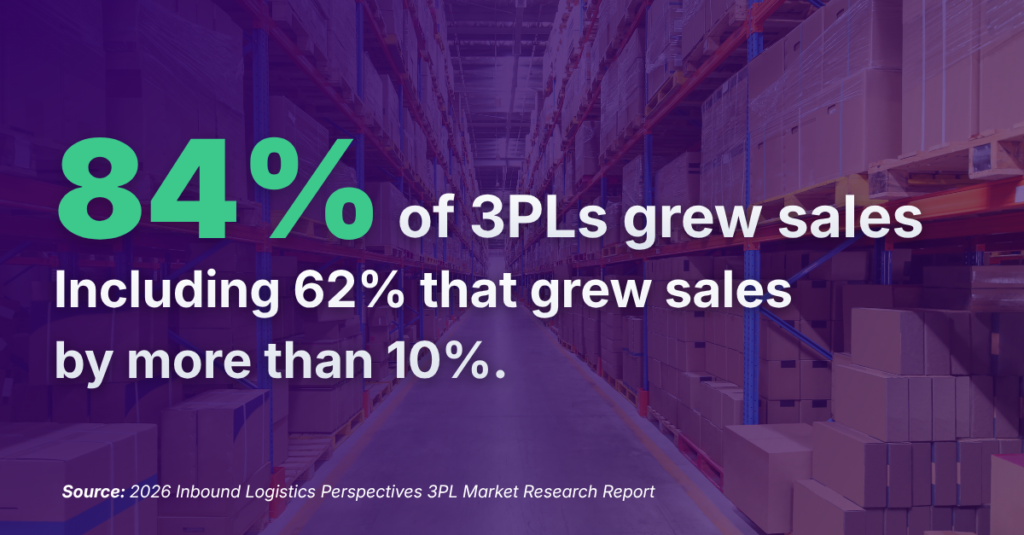
Growth is good news. It also creates new operational complexity.
Every new customer brings different service-level agreements, billing requirements, workflows, integrations, and reporting expectations. A warehouse management system (WMS) that worked well supporting a handful of customers and facilities can begin to show its limitations as operations expand.
For many mid-market 3PLs, the catalyst for evaluating a new WMS isn’t that the current platform has failed. It’s that business growth exposes limitations that were manageable at a smaller scale. The challenge isn’t replacing a broken system. It’s making sure technology can continue supporting growth without adding operational complexity.
AI Is Moving from Promise to Operational Priority
The report found that 93% of 3PLs believe artificial intelligence will have the greatest impact on logistics, while 73% of shippers identified implementing AI as their biggest current challenge.
The research doesn’t suggest that AI alone creates competitive advantage. Instead, it highlights how quickly expectations are changing across both logistics providers and their customers.
Customers increasingly want to know what AI actually does. Can it identify exceptions before they become problems? Can it help warehouse teams make faster decisions? Can it reduce manual analysis?
Those are the questions buyers are increasingly asking.
Better Service Starts with Better Visibility
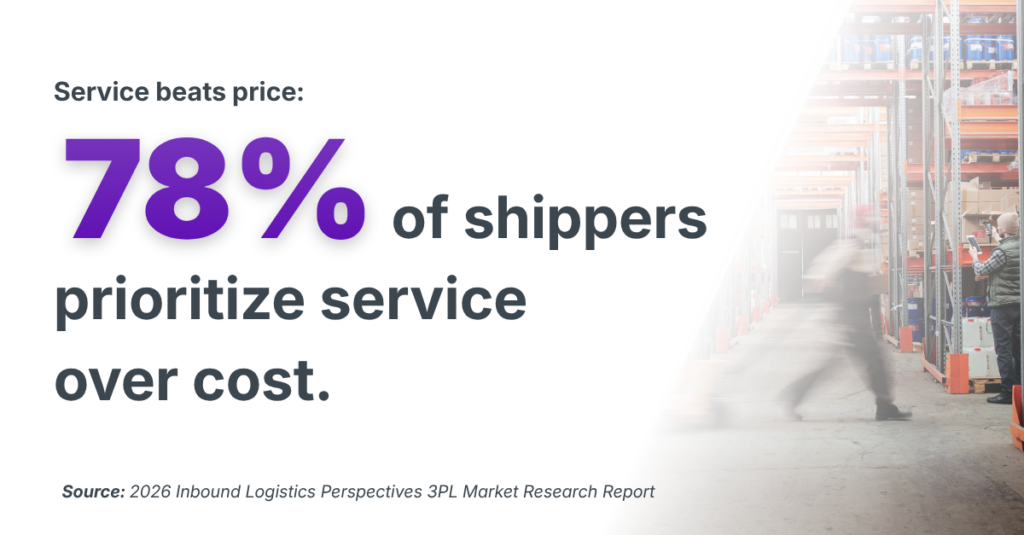
Another important finding from the report is that 78% of shippers prioritize service over price when evaluating a logistics provider. At the same time, 83% of 3PLs identified visibility capabilities as one of their primary technology offerings.
Taken together, these findings raise an important question for warehouse operators: how much of the customer experience now depends on operational visibility?
Increasingly, excellent customer service begins with operational visibility. When customers can see inventory, monitor order status, and receive proactive updates without having to call or email, service naturally improves.
Real-time visibility strengthens customer relationships by reducing uncertainty and allowing warehouse teams to focus on solving problems instead of answering routine status questions.
From Industry Trend to Warehouse Strategy
The findings from the 2026 Inbound Logistics 3PL Perspectives Report highlight broader shifts across the logistics industry. The table below summarizes how those trends can influence warehouse technology decisions.
| What Inbound Logistics Found | What It Means for 3PLs | What to Look for in a WMS |
|---|---|---|
| Growth is returning. 84% of 3PLs reported sales growth, while 77% added new customers. | Growth increases operational complexity as new customers introduce unique workflows, SLAs, billing requirements, and integration needs. | A configurable platform that supports rapid customer onboarding, adapts to different customer requirements, and scales without adding unnecessary complexity. |
| AI has become an expectation. 93% of 3PLs believe AI will have the greatest impact on logistics, while 73% of shippers identify AI implementation as their biggest challenge. | Buyers increasingly expect AI to deliver measurable operational value rather than simply checking a technology box. | AI capabilities that help warehouse teams identify exceptions, answer operational questions, and make faster, more informed decisions. |
| Service wins over price. 78% of shippers prioritize service over price when evaluating a logistics provider. | Customer experience increasingly depends on transparency, responsiveness, and proactive communication. | Real-time visibility, self-service customer portals, alerts, and operational insights that help warehouse teams resolve issues before customers need to ask. |
Source: 2026 Inbound Logistics 3PL Perspectives Report. Interpretations and technology considerations are Datex’s analysis of the research findings.
The Takeaway
One of the clearest takeaways from this year’s Inbound Logistics 3PL Perspectives Report is that expectations are changing.
3PLs are reporting strong growth, customer expectations continue to rise, and warehouse technology increasingly plays a role in how effectively 3PLs can scale, serve customers, and respond to changing expectations.
For 3PLs evaluating whether their current warehouse technology is ready for the next phase of growth, these findings raise several important questions:
- Can we onboard new customers without adding unnecessary complexity?
- Are we providing the visibility customers increasingly expect?
- Can our technology help teams make faster, better operational decisions?
- Is our warehouse platform positioned to support the business we want to become, not just the business we are today?
The right WMS should remove barriers to growth, turn visibility into action, and help teams make better decisions faster.
If these questions are prompting a closer look at your current warehouse technology, explore how Footprint® WMS supports complex, growing 3PL operations.
We also encourage you to read the complete 2026 Inbound Logistics 3PL Perspectives Report for the full research and industry findings, and don’t miss the Top 100 3PL list starting on page 92.
2026 3PL Trends and WMS: Frequently Asked Questions
1. What is the Inbound Logistics 3PL Perspectives Report?
The Inbound Logistics 3PL Perspectives Report is an annual industry study, now in its 21st year, examining the priorities, challenges, technology investments, and market trends shaping third-party logistics providers and the shippers they serve. Datex sponsored the 2026 edition.
2. What are the biggest 3PL industry trends in 2026?.
The 2026 Inbound Logistics 3PL Perspectives Report points to several important trends, including strong 3PL growth, increasing interest in AI, and rising expectations around service and visibility. Among surveyed providers, 84% reported sales growth and 77% added new customers, while 93% said AI will have the greatest impact on logistics.
3. What should 3PLs look for when evaluating a WMS?
A 3PL WMS should be built for the complexity of managing multiple customers within the same operation. That means supporting multiclient inventory, activity-based billing, integrations, client-facing visibility, and, critically, the configurability to accommodate different customer workflows, rules, and service requirements without extensive customization.
Growing 3PLs should evaluate how quickly they can onboard new customers, configure workflows as requirements change, add new services, and give teams and customers the visibility they need. The real test isn’t whether the WMS supports today’s operation. It’s how easily it can adapt as customers, services, and complexity grow.
4. How is AI changing warehouse management for 3PLs?
AI is increasingly being applied to operational decision-making, exception management, analytics, and warehouse visibility. The 2026 Inbound Logistics research found that 93% of 3PLs believe AI will have the greatest impact on logistics, while 73% of shippers identify AI implementation as their biggest current challenge. The opportunity is moving from interest in AI to practical applications that improve warehouse operations.
5. Why is warehouse visibility important for 3PLs?
Visibility directly supports the service experience 3PL customers increasingly expect. Real-time access to inventory and order information, proactive alerts, and self-service capabilities can reduce uncertainty, improve responsiveness, and help warehouse teams address issues before they become customer problems.
A client portal improves 3PL visibility by centralizing all logistics data into a single, accessible dashboard. Instead of relying on emails and spreadsheets, clients can log in anytime to see live data on inventory, order fulfillment, and shipping, eliminating information gaps and enabling proactive decision-making.