
A platform built to execute flawlessly for a single hospital pharmacy or a single pharmaceutical distribution center does not automatically translate to a warehouse running twelve client contracts under one roof, each with its own billing rules, labeling, and SLAs, and the next onboarding already on the calendar.
That mismatch shows up as cost not seen right away. Client-specific billing rules get bolted on instead of built in, workflow changes wait on a developer or a services ticket, and every audit turns into a spreadsheet reconciliation. Those are the costs worth pricing out before you renew.
What follows maps the five areas where that mismatch actually plays out: billing flexibility, workflow configuration, regulated inventory, scalability, and implementation cost, along with Tecsys alternatives for complex, multi-client, and regulated 3PLs put through that test.
How we evaluated these platforms:
Based on public documentation, analyst research, customer reviews/interviews, and publicly available case studies. The goal is to help buyers understand which operational profiles align with each platform, rather than to rank vendors.
Where Tecsys Fits, and When to Compare
On its own website, Tecsys states it was founded in 1983 and is headquartered in Montreal, Canada. Tecsys markets its Elite™ supply chain platform around warehouse management, transportation management, delivery management, and 3PL billing management on a single low-code, cloud-based core.
Tecsys has been named a Challenger in the 2026 Gartner® Magic Quadrant™ for Warehouse Management Systems, which the company states is its 15th consecutive year recognized in that report, and a Leader in the 2024 Nucleus Research WMS Technology Value Matrix. The company positions itself around execution in complex, regulated environments, with a named focus on healthcare: hospital pharmacy, medical and pharmaceutical distribution, and life sciences manufacturing, alongside wholesale distribution, industrial, and 3PL operators.
Tecsys’s own pharmaceutical distribution page, current as of this writing, states that its WMS “embeds DSCSA requirements directly into warehouse workflows,” covering serialized receiving, inventory movement, and shipping. This is Tecsys’s own positioning; organizations should confirm current serialization capabilities directly with the vendor during evaluation.
Tecsys credits its patented Visual Logistics technology with improving worker efficiency and accuracy “by double digits.” It also states that it has over 1,000 customer sites in more than 100 countries. These figures are Tecsys’s own, self-reported and not independently audited. See Gartner Peer Insights and G2 for current customer reviews.
Organizations evaluating Tecsys often prioritize:
- Analyst-recognized depth across warehouse, transportation, and delivery management on one platform
- Embedded DSCSA serialization support for pharmaceutical and healthcare distribution
- A track record in complex, regulated, and mission-critical operating environments
- Low-code configurability delivered through the Elite platform
If that sounds like your operation, Tecsys is worth taking seriously as-is. The calculus changes once a lighterweight, more configurable platform, or one purpose-built around multi-client 3PL billing, moves up the priority list, whether you’re buying a first dedicated WMS, replacing Tecsys, or finally retiring a legacy system. In any of those cases, the same five areas end up deciding the outcome:
- Billing flexibility: rules, accessorials, kitting, and value-added work that differ client to client
- Workflow configuration: processes that change per client without turning into a custom-code project
- Regulated inventory: cold storage, life sciences, food and beverage, or precious metals, where lot, serial, and batch traceability and audit-readiness carry real weight
- Scalability: the practical ceiling on adding a fourth, fifth, or tenth warehouse before inventory drifts and reporting breaks by site
- Implementation and cost: what a realistic go-live costs in time and headcount, and whether per-client pricing holds steady as the roster grows, not just the sticker price
Recognize your operation in several of those, and the real question becomes how to evaluate the alternatives without drowning in feature lists.
Is It Time to Replace Your WMS?
Before you start evaluating vendors, it’s worth checking whether the friction is really about the platform, or about running a multi-client operation on a platform built for something else. A few signals point to the latter:
- System inventory counts drift from what’s actually on the shelf, and there’s no real-time visibility to catch it before a client does.
- Every new ERP, ecommerce, carrier, or automation connection turns into a custom development project instead of a configuration change.
- Accessorials and value-added work routinely go unbilled, or someone reconciles them by hand at month-end.
- A new client onboarding, or a workflow change for an existing one, sits in a developer’s queue or a support ticket.
- Audit prep means building a spreadsheet from scratch instead of pulling a system-generated trail.
- Adding a warehouse throws off reporting consistency, and inventory stops balancing cleanly across sites.
- Total cost of ownership grows faster than the value coming back as clients, users, and order volume scale up.
A few of these landing close to home are the real trigger to start evaluating alternatives built for multi-client complexity rather than single-domain execution. None of it sounding familiar means your current platform is still doing its job.
Evaluate 3PL WMS Alternatives: Criteria and Vendor Questions
Set your requirements before any vendor conversation starts, then hold every platform to the same bar:
- Can workflows be reconfigured without writing custom code?
- How does the platform handle client-specific billing rules, accessorials, kitting, and other value-added services (VAS)?
- What does the billing engine capture automatically, and what still needs a manual entry?
- What compliance features and certifications exist, and how is an audit trail produced?
- What’s the process when a client asks for a new workflow mid-contract?
- What implementation resources and timeline should you budget for?
- How does pricing scale with clients, users, and order volume, and are there per-client fees?
Sorting those into evaluation areas makes the comparison easier to run:
| Evaluation Area | Questions to Ask |
|---|---|
| Billing | Do billing rules flex per customer, and are accessorials picked up automatically instead of by hand? |
| Compliance | What regulatory frameworks does it cover, and where does the audit trail actually come from? |
| Configuration | Who’s authorized to change a workflow, and what’s the real turnaround time? |
| Automation | Which automation and robotics vendors does it plug into? |
| Integrations | What connects out of the box: open APIs, EDI, distributed order management (DOM)? |
| Reporting | Do reports break down by client and by site, and are they live or delayed? |
| Scalability | What actually happens, operationally, when a warehouse or client gets added? |
These areas don’t carry equal weight for every operation.
Let your biggest current challenge decide what to prioritize:
| If your challenge is… | Consider prioritizing… |
|---|---|
| Running many clients under one roof | Configurability and workflows built per customer |
| Billable work slipping through unbilled | Automated charge capture and tighter billing controls |
| Client workflows that keep changing | Low-code adaptability, no custom development required |
| Pharma, cold chain, or food-safety compliance | Native lot/serial and temperature tracking with a real audit trail |
| Connecting to automation, ERP, or carriers | Open APIs and pre-built connectors across the board |
| Adding warehouses faster than reporting keeps up | A system built to add a warehouse without every report needing to be rebuilt |
| Getting live fast on a standardized rollout | Templated, out-of-the-box workflows built for speed |
| Selling across a lot of ecommerce channels | Broad marketplace, cart, and app-ecosystem integrations |
| Peak-season order volume and throughput | Automation, robotics, and throughput built to absorb it |
| Depth specifically in healthcare or pharma distribution | Embedded serialization, chain-of-custody, and pharmacy-specific workflows |
Translated into an actual Tuesday, that prioritization looks like this:
- Billing by temperature zone or catch weight? Check whether the billing engine captures those charges automatically instead of through manual adjustments.
- A client asking for a new pick, pack, or labeling workflow mid-contract? Check how each platform lets you configure it, and whether that change waits on a developer.
- Onboarding your fifth or fifteenth warehouse? Check multi-site architecture and whether reporting stays consistent and client-level across sites.
- Mostly standardized ecommerce volume? Weigh speed to deploy and out-of-the-box channel integrations ahead of deep configurability.
- Pharmaceutical or healthcare distribution as a core line of business? Check how each platform documents serialization and chain of custody, and whether that lives natively in the workflow or bolts on as a separate module.
None of these carries every operation. Weight the ones that match yours, then bring them into the vendor conversations. Here’s how complex 3PLs commonly line up the field once they’ve done that.
The Alternatives Worth Evaluating
The alternatives below represent different WMS approaches a complex 3PL may consider, based on each vendor’s public positioning.
Datex (Footprint WMS): A low-code, configurable 3PL WMS in the market since 1978. Best known for per-client
configuration through Datex Studio, a multi-client billing engine, and compliance tooling built for regulated and
cold-chain operations.
Extensiv (formerly 3PL Central): A cloud fulfillment and order management platform built for 3PLs, with a focus
on multi-client billing and EDI.
Infios (formerly Körber): A supply chain execution suite spanning entry-level to enterprise, built around automation and robotics across warehouse, order, and transportation management.
Manhattan Associates: An enterprise supply chain suite known for depth of functionality and throughput at high
order volume.
What each platform is only tells half the story. It also helps to look at the operational profiles each vendor emphasizes:
| Platform | Operational profiles emphasized |
|---|---|
| Tecsys | Healthcare and pharmaceutical distribution, hospital point of use, complex regulated multi-site operations |
| Datex | Multi-client 3PLs, regulated warehousing, cold chain, life sciences and pharmaceutical distribution |
| Extensiv | 3PLs built primarily around ecommerce fulfillment |
| Infios | Warehouses running heavy automation |
| Manhattan | Large-scale enterprise distribution operations |
A table gets you to a shortlist. Only a demo tells you if it’s right.
Evaluating a WMS for Life Sciences and Pharmaceutical 3PLs
Life sciences and pharmaceutical work raise the bar on a 3PL WMS in ways general fulfillment does not. Whether you handle clinical materials, cGMP warehousing, or prescription drug distribution, the questions change:
- Is lot, serial, and batch traceability native to the workflow, or a bolt-on module?
- Can the platform document chain of custody from receipt through release, including nested serialization for cases and pallets?
- How are suspect or illegitimate products quarantined, investigated, and released?
- What audit trail does the system generate, and how long does it take to produce one under inspection?
- Which controls support cGMP, 21 CFR Part 11, and DSCSA efforts, and what validation work stays your responsibility?
Life sciences also covers segments with meaningfully different requirements. A clinical trial materials depot, a cGMP contract warehouse, and a pharmaceutical wholesale distributor subject to DSCSA serialization do not need the same system. Scope your requirements to your segment before comparing platforms, since a vendor with depth in hospital point-of-use dispensing is not necessarily the same vendor with depth in multi-client cGMP warehousing.
Validate Your Shortlist in a Demo
A vendor overview tells you what a platform can theoretically do. Make each finalist prove it against your real workflows, your own clients, contracts, and SLAs:
- Run the billing engine against one of your actual client contracts, accessorials and value-added work included.
- Ask them to configure a new client workflow live, on the spot, and note whether it needs engineering to pull off.
- Have them show lot/serial and temperature traceability, and how an audit trail actually gets produced.
- If regulated pharmaceutical or healthcare inventory is part of your operation, make them demo serialization and chain-of-custody workflows end to end, not just describe them.
- Walk client-level reporting across multiple warehouses, not a single-site demo environment.
- Map their pricing to your growth curve: more clients, more users, more order volume.
- Get references from operations that actually resemble yours.
Layer in implementation, integration, and support costs to get to a real total cost of ownership (TCO), and compare platforms on that number, not the license price.
Every operational profile should run on that same checklist. Ecommerce-heavy 3PLs will weigh channel integrations and speed to deploy more heavily. Highly automated operations will weigh robotics’ support and throughput. Enterprise distributors will weigh suite breadth across warehouse, transportation, and order management. The evaluation areas and demo questions above apply the same way to each, what changes are which answers matter most to you.
Compare Every WMS Demo on the Same Criteria
Our free Demo Day Question Playbook is a fillable, printable checklist that scores each vendor on the questions above, so you can compare them side by side and share the results with your team.
Using that approach, one operational profile becomes especially relevant to Datex: the multi-client, regulated, billing-heavy operation this guide opened with.
Organizations Evaluating Datex
Organizations evaluating Datex Footprint WMS tend to share a profile: multi-client, regulated, and billing-heavy. What they’re usually trying to solve for:
- Multi-client complexity that a single-workflow platform wasn’t built to absorb
- Workflows that differ by customer, not just by warehouse
- Billing and revenue events complex enough that missing one is easy
- Compliance requirements that run through daily operations, not just year-end audits
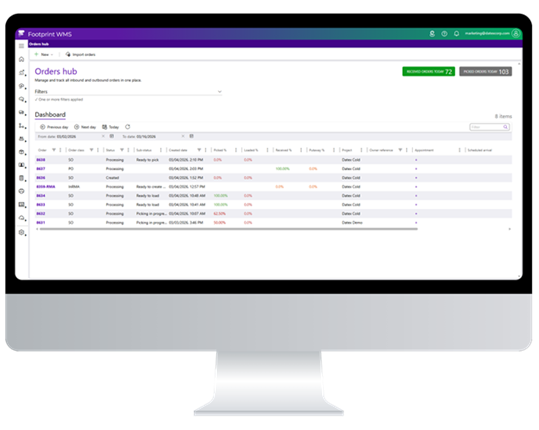
In practice, that means a configurable billing engine that captures every billable task as it happens, so value-added work does not go unbilled; low-code Datex Studio, so teams can change a client’s workflow without pulling in developers; and built-in tools that may support FSMA, DSCSA, and 21 CFR Part 11 efforts for regulated inventory, alongside AI-assisted features across the platform. Weigh each of these against your own requirements, the same way you would weigh any vendor’s claims. The combination tends to matter most in regulated, temperature controlled operations: cold storage, life sciences, food and beverage, precious metals.
Datex may not be the right call if:
- you ship DTC ecommerce exclusively
- your workflows are already fully standardized across clients
- lowest initial cost is the deciding factor
- configurability isn’t something you need
- what you actually need first is an OMS, not a WMS
- you specifically need a platform already embedded in hospital point-of-use or pharmacy dispensing workflows
Any of those point toward a platform built for that specific use case, or a broader enterprise suite, as the more natural fit. Check the Footprint WMS 3PL Capabilities to see how multi-client billing, per-client workflows, client portal, and cold-chain traceability come together in practice. Use it to sharpen your own requirements list, then request a walkthrough built around your own clients, contracts, and SLAs.
Frequently Asked Questions
Look for lot and serial traceability, chain-of-custody documentation, temperature capture at control points, quarantine and hold controls, and audit trails, capabilities that may support DSCSA, FSMA, and 21 CFR Part 11 efforts. Ask whether serialization is native to the workflow or a bolt-on module, and validate against your own regulatory requirements.
Timelines vary widely based on project scope and complexity. Straightforward implementations can take 12 weeks or less, while larger, more complex projects may take 12 months or longer. Data quality, integrations, and change management can materially affect implementation outcomes. Ask each vendor for a timeline mapped to your workflows.
In PwC’s 2025 Digital Trends in Operations survey of 610 operations and supply chain leaders, the most common reasons technology investments underdelivered were integration complexity (47%) and data issues (44%).
Manageable, with a plan. When these projects run long, it’s usually data quality, integrations, and change management doing the damage, not the new software. Map your requirements before you start, migrate data in stages, demo your single hardest client scenario, and get references from operations that look like yours.
Datex, Tecsys, Extensiv, Deposco, and Infios are the platforms that come up most among 3PL-friendly WMS options for midmarket operators. Which one fits depends on the operation: regulated, healthcare-adjacent 3PLs with heavy billing complexity tend toward configurable, compliance-ready platforms, while ecommerce-first 3PLs weigh order-volume scaling first.
A WMS can support DSCSA serialization by maintaining serialized data such as SGTIN and SSCC, documenting chain of custody, and controlling suspect or illegitimate product through holds and quarantines. Some platforms, Tecsys among them, market embedded serialization support built specifically for pharmaceutical and healthcare distribution, according to the vendor’s own current site. Datex Footprint WMS includes functionality that may support these workflows; organizations should validate against their own regulatory requirements.
Tecsys has been named a challenger in the 2026 Gartner® Magic Quadrant™ for warehouse management systems (PR Newswire). Datex is recognized separately, for the second consecutive year, as a Notable Vendor in the Midmarket Context: Magic Quadrant™ for Warehouse Management Systems 2025, a companion Gartner report covering midsize enterprises.
The Magic Quadrant places vendors across four categories: Leaders, Challengers, Visionaries, and Niche Players. It covers additional vendors beyond those named here. Analyst placement is one useful input, not a full evaluation. Validate fit against your own billing, compliance, and configurability requirements in a demo, and review independent user feedback on Gartner Peer Insights.
Methodology
This comparison is based on publicly available information, product documentation, summarized customer reviews, and published case studies as of July 2026. Competitor descriptions reflect each vendor’s own public positioning. Datex product details and customer results come from Datex, and customer outcomes are customer-reported. Features, pricing, and capabilities change over time, so validate requirements directly with each vendor during evaluation.