
Multiple clients share your warehouse, and no two run the same way. Each has its own billing rules, labeling, SLAs, and compliance demands, and the next onboarding is already booked.
On a standardized WMS, that complexity leaks money. Value-added work goes unbilled, workflow changes wait weeks on a developer, and every audit turns into a spreadsheet scramble. When the platform starts costing more than it saves, it is time to compare your options.
This guide breaks down the Deposco alternatives that complex, multi-client, and regulated third-party logistics (3PL) providers actually evaluate, and how to tell which one fits how you run.
How we evaluated these platforms:
Based on public documentation, analyst research, customer reviews/interviews, and publicly available case studies. The goal is to help buyers understand which operational profiles align with each platform, rather than to rank vendors.
Where Deposco Fits, and When to Compare
Deposco describes itself as an AI-driven supply chain fulfillment platform that unifies warehouse and order management in one system. The emphasis is speed: on its own website, Deposco cites 150+ pre-built integrations, which it calls the industry’s largest library, and a 90-day-or-less implementation target. That focus on fast, standardized deployment is how Deposco positions itself, around a stated customer base of high-growth ecommerce, DTC, and omnichannel brands.
These figures are Deposco’s own, self-reported and not independently audited. For independent user reviews of Deposco, see Gartner Peer Insights and G2.
Organizations evaluating Deposco often prioritize:
- Fast time-to-value and standardized, repeatable workflows
- Unified warehouse and order management in a single platform
- High-growth ecommerce, DTC, and omnichannel retail fulfillment
- AI-assisted planning and a broad pre-built integration library
If that mirrors your operation, Deposco may be a strong fit. The picture changes when complexity becomes the everyday reality. Buyers reach that point for different reasons: a first dedicated WMS, a Deposco replacement, or a move off a legacy system. Either way, the evaluation comes down to the same five areas:
- Billing flexibility: client-specific rules, accessorials, kitting, and value-added work
- Workflow configuration: changing processes per client without custom code
- Regulated inventory: cold storage, life sciences, food and beverage, or precious metals, where traceability and audit-readiness matter
- Scalability: growing from one site to five-plus, with inventory balanced and reporting consistent across warehouses
- Implementation and cost: time, resources, how pricing changes as clients grow, and total cost of ownership (TCO) to go live
If several of those describe your operation, the next question is how to evaluate the alternatives without drowning in feature lists.
Is It Time to Replace Your WMS?
Before comparing vendors, it is worth asking whether you need to switch at all. A few signals that a platform may be limiting an operation rather than supporting it:
- Inventory counts in the system regularly disagree with what is on the shelf, or real-time visibility is missing.
- Connecting the WMS to your ERP, ecommerce channels, carriers, or automation takes custom code or drawn-out projects.
- Value-added work and accessorials charges regularly go unbilled or need manual reconciliation.
- Onboarding a new client, or changing an existing client’s workflow, waits on a developer or a support ticket.
- Audit prep relies on manual spreadsheets instead of a system-generated audit trail.
- Total cost of ownership climbs faster than the value you get back as clients, users, and order volume grow.
If none of this sound familiar, your current WMS may still be the right tool. If several do, the next step is to compare alternatives against your specific requirements.
How to Evaluate the Alternatives
Start any 3PL WMS comparison from your own requirements, then measure each platform against them. Ask every vendor the same questions:
- Can workflows be configured without custom code?
- How are client-specific billing rules, accessorials, kitting, and value-added services (VAS) handled?
- How does the billing engine capture every billable task automatically?
- What compliance features and certifications are available, and how are audits supported?
- What happens when a customer requests a new workflow?
- What implementation resources and timeline are required?
- How does pricing change as clients, users, and order volume grow, and are there per-client fees?
To keep those organized, group them by evaluation area:
| Evaluation Area | Questions to Ask |
|---|---|
| Billing | Can billing rules differ by customer? Are accessorials captured automatically? |
| Compliance | Which regulations are supported? How are audit trails maintained? |
| Configuration | Who can make workflow changes, and how fast? |
| Automation | Which automation and robotics vendors are supported? |
| Integrations | Integration methods: are open APIs, EDI, and distributed order management (DOM) supported? |
| Reporting | Are reports client-specific, multi-site, and available in real time? |
| Scalability | How cleanly does the platform add warehouses and clients? |
Not every area carries the same weight for every operation.
Use your biggest challenge to decide what to prioritize:
| If your challenge is… | Consider prioritizing… |
|---|---|
| Multi-client complexity | Configurability and customer-specific workflows |
| Revenue leakage from missed billing events | Advanced billing controls and automated charge capture |
| Frequent workflow changes as clients evolve | Low-code adaptability: configure without custom development |
| Strict compliance (pharma, cold chain, food safety) | Native compliance features: lot/serial, temperature, audit trails |
| Integrations with automation, ERP, or carriers | Open APIs and pre-built connectors for automation tools, ERP systems, and carrier networks |
| Scaling across multiple warehouses | Multi-site architecture with centralized, client-level reporting |
| A fast, standardized launch | Speed to deploy and templated, out-of-the-box workflows |
| Selling across many ecommerce channels | Marketplace, cart, and broad app-ecosystem integrations |
| High order volume and peak throughput | Warehouse automation, robotics, and throughput optimization |
It helps to translate that into your own day-to-day. A few common patterns:
- If you invoice by temperature zone or by catch weight, evaluate platforms whose billing engine captures those charges automatically rather than through manual adjustments.
- If a client asks for a new pick, pack, or labeling workflow mid-contract, evaluate how each platform lets you configure it, and whether the change waits on a developer.
- If you store pharma, food, or other regulated inventory, evaluate lot and serial traceability, temperature capture at control points, and how fast each platform can produce an audit trail.
- If you are onboarding your fifth or fifteenth warehouse, evaluate multi-site architecture and whether reporting stays consistent and client-level across sites.
- If most of your volume is standardized ecommerce orders, evaluate speed to deploy and out-of-the-box channel integrations ahead of deep configurability.
No single platform leads on every one of these. Weight the ones that match how you run, then carry them into the vendor conversations. With that lens, here are the platforms complex 3PLs most often put through it.
The Alternatives Worth Evaluating
These are the WMS alternatives to Deposco that complex 3PLs most often evaluate. Each is described by what it is known for, based on the vendor’s own public positioning on its website.
Datex (Footprint WMS): A configurable, low-code 3PL WMS operating since 1978, known for per-client configuration (Datex Studio), a multi-client billing engine, and built-in compliance tools for regulated and cold-chain operations.
Extensiv (formerly 3PL Central): A 3PL-focused cloud fulfillment and order management platform, known for multi-client billing and EDI.
Infios (formerly Körber): An entry-to-enterprise supply chain execution suite, known for automation and robotics across warehouse, order, and transportation management.
Manhattan Associates: An enterprise-grade supply chain suite, known for depth and throughput at high volume.
Knowing what each platform is tells you only half of it. The other half is who tends to run on it, because that is the fastest signal of fit:
| Platform | Frequently evaluated by |
|---|---|
| Deposco | Ecommerce fulfillment, omnichannel retail, DTC |
| Datex | Multi-client 3PLs, regulated warehousing, cold chain |
| Extensiv | Ecommerce-focused 3PLs |
| Infios | Highly automated warehouse operations |
| Manhattan | Large enterprise distribution |
A table narrows the field. A demo decides it.
Pressure-Test Your Shortlist in a Demo
Vendor overviews only get you so far. Have each vendor run the demo against your real workflows, with your own clients, contracts, and SLAs:
- Have the billing engine run one of your real client contracts, including accessorials and value-added work.
- Configure a new client workflow live, and note whether it needs engineering.
- Show lot/serial and temperature traceability, and how an audit trail is produced.
- Walk through client-level reporting across multiple warehouses.
- Map pricing to your growth: more clients, users, and order volume.
- Ask for references from operations like yours.
Factor in implementation, integration, and support to get the real total cost of ownership (TCO), then compare platforms on that.
Run every demo the same way:
Our free Demo Day Question Playbook is a fillable, printable checklist that scores each vendor on the questions above, so you can compare them side by side and share the results with your team.
Doing so, one profile tends to separate quickly: the multi-client, regulated, billing-heavy operation this guide opened with. Since that is the profile Datex centers on, it is worth looking more closely at how it fits.
When Buyers Typically Shortlist Datex
The 3PLs that shortlist Datex Footprint WMS often have these characteristics: multi-client, regulated, and billing-heavy operations. Organizations evaluating it prioritize managing multi-client complexity, customer-specific workflows, capturing complex billing and revenue events, and compliance-heavy operations.
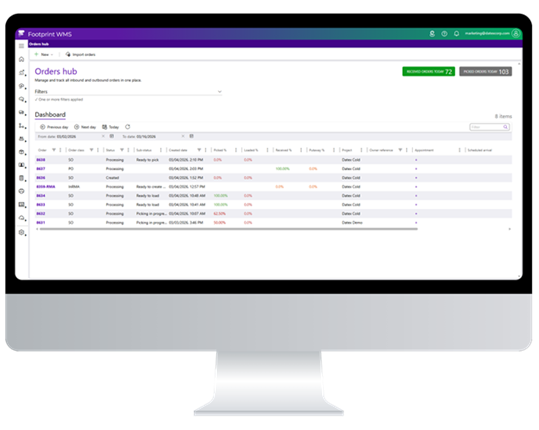
Mapped to those priorities, that means a configurable billing engine that captures every billable task as it happens, so value-added work does not go unbilled; low-code Datex Studio so teams can change a client’s workflow without developers; and built-in tools that may support FSMA, DSCSA, and 21 CFR Part 11 efforts for regulated inventory, alongside AI-assisted features across the platform.
Weigh each of these against your own requirements, the same way you would weigh any vendor. That mix tends to matter most in regulated, temperature-controlled operations, from cold storage and life sciences to food and beverage and precious metals.
When Datex may not be ideal:
- you only ship DTC ecommerce
- all your workflows are standardized
- you want the lowest initial cost
- you don’t need configurability
- you’re looking for an OMS before a WMS
In those cases, a more ecommerce-native or self-serve platform is usually the more natural choice.
To see whether it fits your operation, review the Footprint WMS 3PL Capabilities: how multi-client billing, per-client workflows, client portal, and cold-chain traceability come together, and use them to shape your requirements list. From there, you can request a walkthrough on your own clients, contracts, and SLAs.
Frequently Asked Questions
Start with how your operation actually runs. For a multi-client 3PL, four things decide fit: billing capture on every billable task, compliance support for regulated inventory, per-client configuration without custom development, and clean scaling across warehouses.
Simpler cloud deployments can go live in weeks, while enterprise suites often run 6 to 18 months. The bigger variable is rarely the software, but data quality, integrations, and change management. In PwC’s 2025 Digital Trends in Operations survey of 610 operations and supply chain leaders, the most common reasons technology investments underdelivered were integration complexity (47%) and data issues (44%). Ask each vendor for a timeline mapped to your workflows.
Switching is manageable with a plan. Projects most often run long due to data quality, integrations, and change management, and the software choice is rarely the issue. Reduce risk by mapping your requirements first, migrating data in stages, demoing your hardest client scenario, and asking each vendor for references from similar operations.
Among 3PL-friendly WMS platforms, mid-market 3PLs commonly evaluate Datex, Deposco, Extensiv, and Infios. The right pick depends on operational fit: regulated and cold-chain 3PLs with heavy billing complexity often lean toward configurable, compliance-ready platforms, while ecommerce-first 3PLs weigh order-volume scaling first.
There is no single right WMS, only the right fit. A mid-size 3PL’s shortlist usually tracks the work: Datex for complex, regulated, billing-heavy operations; Extensiv for ecommerce-centric 3PLs; and Deposco for high-growth omnichannel brands. Your billing, compliance, and configurability needs should drive the choice.
For cold storage, look for native lot-level traceability, temperature capture at control points, catch-weight handling, and audit trails, capabilities that may support FSMA and food-safety efforts. Platforms purpose-built for cold-chain 3PLs, Datex among them, focus on these.Validate any platform against your own regulatory requirements before relying on it.
For controlled environments like cold storage, pharma, and food and beverage, look for native lot/serial traceability, temperature capture, catch-weight handling, and audit trails, capabilities that may support FSMA, DSCSA, and 21 CFR Part 11 efforts. Datex, Infios, and Manhattan are commonly evaluated.
Look for a billing engine that captures accessorials and value-added services automatically, and applies per-client contract rules without manual reconciliation. Datex and Extensiv are both commonly evaluated for multi-client 3PL billing. Confirm in a demo how each handles your real contracts.
For multi-client billing and contracts, look for a WMS that applies per-client contract rules and captures accessorials, kitting, and value-added services as billable events automatically. 3PLs commonly evaluate Datex, Extensiv, and Deposco for this. Test each against one of your real client contracts before deciding.
For kitting, labeling, special handling, and other value-added services, look for a WMS that logs each VAS task as a billable event and ties it to the right client contract. That stops revenue leaking through unbilled work. 3PL-focused platforms such as Datex and Extensiv are built with this in mind.
Warehouse managers running complex, multi-client operations commonly use configurable 3PL WMS platforms such as Datex, Extensiv, and Infios. Fit depends on how much each client’s workflows, billing, and SLAs differ. When workflows keep changing, low-code configurability matters more than the length of a feature list.
The most scalable WMS for a 3PL has multi-site architecture, centralized and client-level reporting, open integrations, and per-client configurability, so onboarding the next client does not require custom development. Evaluate how cleanly a platform supports multi-warehouse operations, balances inventory across sites, and adds clients, not just its peak throughput.
Replacing a legacy, on-prem, or homegrown WMS usually means moving to a modern, cloud-native platform that adapts without heavy development. For complex 3PLs, alternatives worth evaluating include Datex, Deposco, Extensiv, and enterprise suites like Manhattan and Blue Yonder, weighed against your billing, compliance, distributed order management (DOM), and multi-site needs.
In a Datex vs Deposco comparison, both are capable WMS platforms with different strengths. Deposco positions itself around high-growth ecommerce and omnichannel brands wanting fast, standardized deployment. Datex may be appropriate for complex, multi-client 3PLs in regulated or cold-chain environments that need configurable billing and workflows that change without custom development.
Methodology
This comparison is based on publicly available information, product documentation, summarized customer reviews, and published case studies as of July 2026. Competitor descriptions reflect each vendor’s own public positioning. Datex product details and customer results come from Datex, and customer outcomes are customer-reported. Features, pricing, and capabilities change over time, so validate requirements directly with each vendor during evaluation.