
An FDA inspector asks for a full lot trace on a frozen product that shipped six weeks ago. A client questions a catch-weight invoice because the billed weight does not match what they received. And the blast freezer logs a temperature excursion overnight.
Three separate demands, arriving at once, and often handled by systems that do not share data.
If that scene is familiar, you already know cold storage is not ambient warehousing with a colder thermostat. Selecting a warehouse management system (WMS) for a cold storage third-party logistics provider brings requirements that a dry-goods operation does not face, because the complexity compounds.
You run multiple clients under one roof, each with its own temperature zones, labeling rules, billing arrangements, and compliance obligations.
A generic WMS can track pallets. Cold storage needs more: robust inventory management and real-time inventory tracking down to the lot, the ability to trace a lot to the event level FSMA now expects, to capture the actual weight of catch-weight items as they are received, and to let your team stand up a new client’s workflow without waiting on a developer.
This guide is built to help you compare cold-chain platforms on the criteria that actually matter. It covers what makes cold storage requirements different, how to audit your own operation before you shortlist anyone, the capabilities and questions that distinguish purpose-built frozen and refrigerated warehouse management systems from general-purpose platforms, an overview of the platforms cold storage operators commonly evaluate, and how to weigh the vendor relationship itself. Use it to build your own shortlist.
What Makes Cold Storage WMS Requirements Different
Cold storage creates requirements that ambient warehousing does not. The same pallet movements that a WMS tracks also affect product quality, temperature-zone integrity, and the completeness of compliance records.
ReFED valued U.S. surplus food at $382 billion in its 2025 report, with produce and other perishables among the largest contributors. Standard WMS platforms were not designed around these physical and regulatory requirements. Three areas matter most.
Temperature Zones, FEFO, and Date-Code Rotation
Most WMS platforms handle FIFO, first-in-first-out. Perishable inventory needs FEFO, first-expired-first-out, so the system ships by remaining shelf life rather than arrival date.
A platform that tracks only the receipt date will ship newer products while older-dated stock sits behind it, which is what FEFO is designed to prevent.
Cold storage also runs on zone logic. Facilities rarely hold one temperature; they run frozen, refrigerated, blast-freeze, and often sub-zones inside each, sometimes for different clients with different thresholds.
The WMS should track inventory by zone in real time, direct putaway to the correct environment, and stop the task before it happens. If a pallet of ice cream is directed to a +38F cooler instead of a -10F freezer, the system should block that putaway before the operator unloads, not report the mistake after the product has thawed.
Date-code rotation ties these together. The system needs to reason about best-by dates, expiration dates, and hold or quarantine status, and understand that a “best before date” and an “expiry date” are not the same thing.
Catch-Weight Billing and Cold-Specific Accessorials
Selling storage by the pallet is straightforward. Catch-weight billing is more involved: in meat, poultry, seafood, and produce, two cases of the same SKU can weigh different amounts, so the WMS has to capture the actual weight at receiving and at picking to keep both inventory and the invoice accurate.
Weight is only part of it. Cold operations bill charges ambient warehouses do not: blast-freeze fees, re-icing, energy and refrigeration surcharges, plug-in charges for refrigerated containers, and storage-duration billing.
Each is a billable event, often priced differently per client. Capturing them automatically at the point of activity keeps value-added work on the invoice, rather than leaving it to a manual reconciliation at month-end.
FSMA, Lot Traceability, and Recall Readiness
The Food Safety Modernization Act, and specifically the FSMA 204 traceability rule for foods on the Food Traceability List, turned detailed recordkeeping from a nice-to-have into a requirement.
Operations increasingly need to capture Key Data Elements (KDEs) tied to Critical Tracking Events (CTEs) as products move, and produce records to the FDA within 24 hours of a request.
The compliance date has moved: the FDA proposed a 30-month extension to July 20, 2028, and Congress has restricted enforcement before that date, so the smart move is to build the capability now rather than wait.
Confirm your own obligations and current dates with counsel, since rules and enforcement timelines change.
Speed matters most during a hold or recall. How fast can the system produce a complete lot trace, identify every affected pallet across zones and clients, and lock that inventory from shipping?
A cold-chain WMS should maintain a digital chain of custody that yields a full recall report in minutes rather than days. Complete documentation that proves the cold chain is held is what allows the product to be released with confidence.
Audit Your Operation Before You Evaluate
Before you sit through a single demo, take stock of your current operation. A WMS accelerates the process you already run, so it delivers the most value on a process you have already refined. The clearer you are on your own requirements, the more you lead the evaluation rather than letting a demo lead it.
Your Zones, Workflows, and Bottlenecks
Walk your floor. Map the flow from the moment a reefer docks to the moment the BOL is signed, including any cross-docking activities, and mark where time and paper pile up.
How much time do pickers spend in sub-zero zones locating product? Are temperatures or weights still recorded on clipboards?
Manual data capture in the cold is often a bottleneck, and it is usually among the first things a new WMS digitizes. Write down your zones, your peak-day throughput, and the two or three points where your current process is slowest. Those become your must-have list.
Your Client Mix and Existing Hardware
A client storing bulk frozen vegetables has little in common with one running ecommerce order fulfillment, pick-and-pack, and kitting for meal kits.
Audit your client roster: who needs EDI, requires integration with ecommerce platforms and marketplaces, wants real-time inventory visibility, and has client-specific billing or compliance rules. That mix determines how much configurability you actually need.
Then look at hardware. Handheld scanners that move from -20F storage to a humid dock can fog or fail, and Wi-Fi coverage deep inside a freezer is rarely perfect.
Note what devices you have, how rugged they are, and where connectivity drops. Whatever platform you choose still has to run on the hardware you actually have, so put your device and connectivity realities on the table in every vendor conversation.
Evaluation Criteria and Key Capabilities
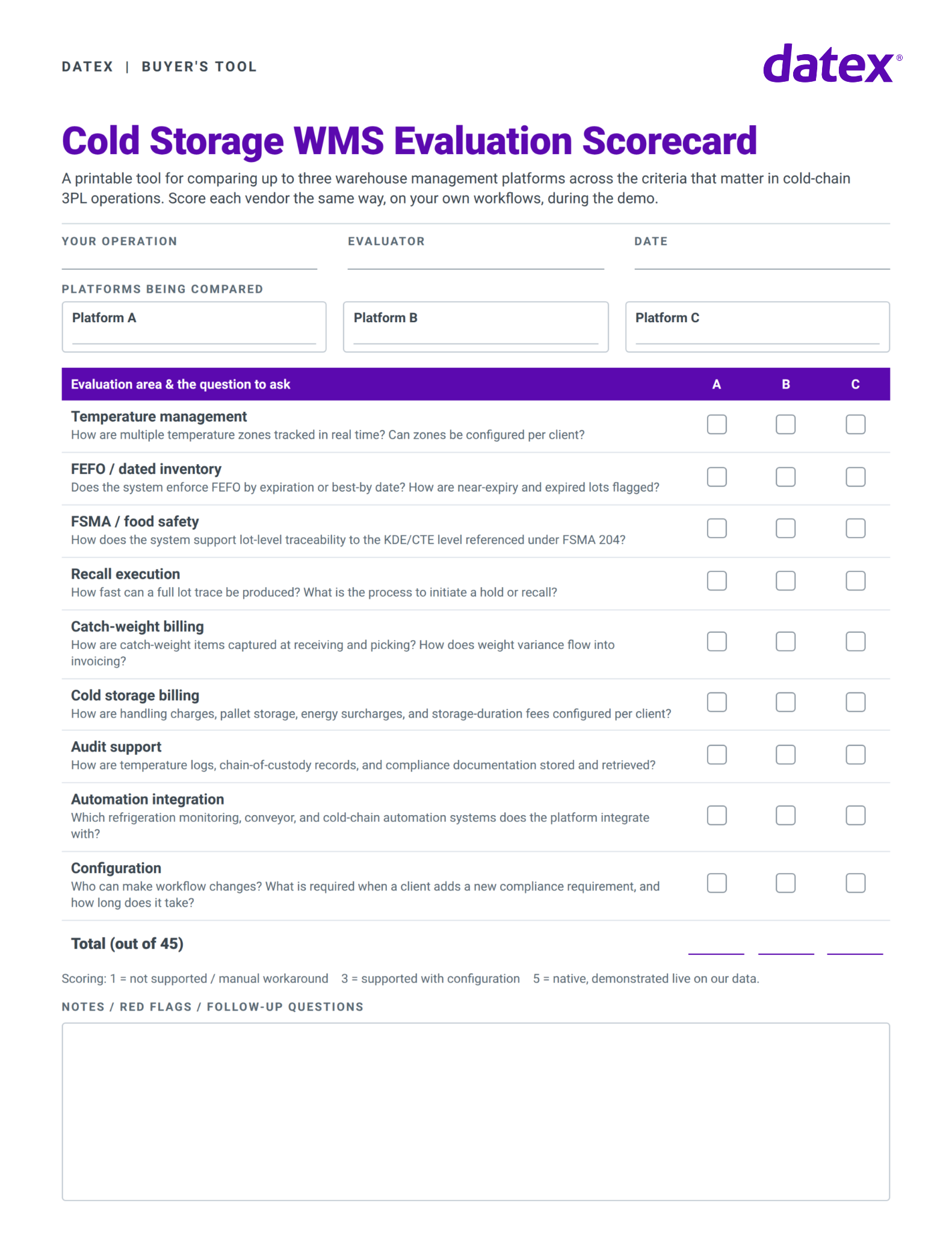
Vendors describe their capabilities in similar terms, so the useful questions reveal how each platform works. Use these three capability pillars as your reference, and go deep on them, because they are where platforms differ most and where fit matters most. A printable version of the criteria below is available as a downloadable scorecard so you can score platforms side by side during demos.
Compliance, Traceability, and Recall Execution
Ask every vendor to run a live recall on sample data: trace a lot from receiving to shipping, and back from a customer to the specific pallet and location.
Ask how a hold status is applied and whether it can instantly lock a lot across the whole warehouse when a supplier issues a warning.
Check that the system records lot-level traceability, capturing the Key Data Elements attached to each Critical Tracking Event under FSMA 204, and that those records can be pulled on demand instead of pieced together after an incident.
Ask whether traceability is native to every transaction or produced as a separate report, since that difference shows up most during a live recall.
Billing, Client Visibility, and Portal Access
In a 3PL, service is the product. A modern cold storage WMS often includes a client-facing web portal where customers see their own inventory, expiration dates, and order status in real time, which cuts down “where is my product?” calls.
Then put the billing engine to the test on something real. Hand the vendor one of your actual client contracts, the kind with tiered storage rates, recurring charges, cold accessorials, and variable catch weights, and watch how much of the invoice the system builds on its own versus how much your team would still key in by hand.
Hardware and Automation for Sub-Zero Environments
The interface needs to be usable by workers in thick freezer gloves. Mobile screens should be high-contrast and simple, so eyes spend less time on a device and more on the surroundings.
Ask what happens to a handheld’s data if Wi-Fi drops while a worker is deep in a freezer, since offline resilience matters where connectivity is intermittent.
If you plan to add AS/RS or high-density racking to cut cooling costs, confirm the platform exposes an open API to communicate with warehouse automation systems and transportation management systems (TMS), and ask about GS1-128 barcode scanning and labeling support for compliant, scannable pallet identification.
Platforms Commonly Evaluated by Cold Storage 3PLs
Below is an overview of the platforms and cold storage 3PL software that appear in cold storage warehouse management software evaluations, described by each vendor’s own public positioning and the segments that commonly evaluate them.
These are not rankings and endorsements. For third-party perspective, buyers often cross-reference verified user reviews on a neutral source such as Gartner Peer Insights. Confirm any specific capability directly with the vendor and against your own requirements.
Datex Footprint® WMS: A configurable, low-code 3PL WMS that positions itself around multi-client operations, flexible billing, and regulated and cold-chain warehousing. Commonly evaluated by multi-client cold storage 3PLs and food and beverage distributors.
made4net: A supply chain execution and warehouse management provider that positions itself around an end-to-end SCE platform spanning warehouse, yard, labor, and transportation. Commonly evaluated by large-scale cold storage operators, food distribution, and 3PL cold chain operations.
Logimax: A warehouse management provider that positions itself around 3PL and food and beverage warehousing, with cold storage features such as temperature-zone management, FEFO, and lot traceability. Commonly evaluated by cold storage and food and beverage 3PL warehouses.
Extensiv: A cloud-based 3PL warehouse management platform that positions itself around multi-client fulfillment, with cold storage capabilities including lot tracking, catch-weight, and directed putaway. Commonly evaluated by ecommerce-focused and cloud-first 3PLs that also run cold storage.
Softeon: A WMS and warehouse execution system (WES) provider that positions itself around configurable warehouse and fulfillment operations, with food and beverage and cold storage capabilities such as lot and batch tracking, shelf-life management, and QA holds. Commonly evaluated by food and beverage distributors and 3PLs.
Blue Yonder, Tecsys, and Infios (formerly Körber): Enterprise-oriented supply chain execution suites with warehouse management and automation heritage, several with dedicated cold-chain capabilities. Commonly evaluated at the larger or highly automated end of the cold storage and food distribution market.
Which operations are typically evaluated on each platform
Organized around the type of operation that tends to shortlist each platform, not around any ranking. A vendor’s typical customer profile is often a faster signal of fit than a feature checklist.
| Platform | Frequently evaluated by |
|---|---|
| Datex Footprint WMS | Warehouses running cold storage for multiple clients, operating under regulation, or distributing food and beverages |
| made4net | Large-scale cold storage operators, food distribution, 3PL cold chain |
| Logimax | Cold storage and food & beverage 3PL warehouses |
| Extensiv | E-commerce-focused and cloud-first 3PLs, including cold storage |
| Softeon | Food and beverage distributors and 3PL/WES operations that need configurable workflows |
| Blue Yonder, Tecsys, Infios (formerly Körber) | Large enterprise and highly automated cold-chain operations |
If your operation looks nothing like a vendor’s usual buyer, that is a signal worth weighing.
Questions to Ask During Demos
Take the wheel during the demo instead of sitting through the vendor’s default walkthrough. Use scenario-based questions on something close to your real data, and note what each one is testing:
- Can you scan one GS1 barcode on an inbound case and show me every field the system pulls from that single scan, like lot, material, weight, and expiration date? (Tests barcode parsing logic and automated data capture.)
- Walk me through a picker entering three separate weights for one SKU on an outbound order. (Tests catch-weight capture.)
- Direct a putaway of frozen product to a cooler zone and show me what the system does. (Tests zone logic and error prevention)
- Show me the complete audit trail for a single pallet, covering every step from receipt to shipment. (Tests traceability and FSMA support.)
- Generate an invoice for a client with three temperature zones, storage-duration charges, and a blast-freeze surcharge. (Tests billing complexity.)
- Walk me through Product Ageing, quarantine, and hold logic on a single lot. (Tests FEFO and food-safety controls.)
- Initiate a recall hold and show how fast a complete lot trace is produced and locked. (Tests recall execution under pressure.)
Consistency is the signal to watch. Note which questions each platform can demonstrate on your own data and which it can only describe.
Evaluating the Vendor Relationship and Implementation
The software is roughly half the decision. The vendor is the other half, because you are entering a multi-year partnership, not a one-time purchase. A vendor fluent in cold-chain specifics, down to the difference between a best-before date and an expiry date, is a useful signal of fit.
Roadmap, Support, and Scalability
Ask to see the product roadmap. Is the vendor investing in areas that matter to cold operations, such as slotting optimization, demand forecasting, automation integration, and compliance modules that keep pace as FSMA guidance evolves?
Ask how the platform scales as you add clients, zones, and facilities, so onboarding the next account does not require custom development each time.
Then pressure-test support: if the system has trouble at 3 a.m. on a Saturday during a seasonal peak, who answers, and how fast?
A cold operation runs around the clock, so get 24/7 support and a defined escalation path confirmed in writing.
Data Migration and Team Adoption Without the Growing Pains
The largest risk in a WMS project is usually the transition rather than the software itself. A phased cutover generally carries less risk than switching everything overnight.
Ask each vendor about migration methodology: can they run the new system in parallel with your current one for a period, and how do they migrate live inventory data without losing a pallet’s history?
Ask about adoption, too. A “train-the-trainer” program and role-based training help floor staff get productive quickly, which protects throughput during the switch.
The pattern shows up in the data: in PwC’s 2025 Digital Trends in Operations survey of 610 operations and supply chain leaders, 92% said their technology investments had not fully delivered, with integration complexity (47%) and data issues (44%) as the most common reasons.
In other words, weigh the vendor’s implementation and integration track record as heavily as the feature list.
Why Some Cold Storage 3PLs Evaluate Datex Footprint WMS
The criteria above apply to any platform. For readers weighing Datex specifically, here is how Footprint WMS, a configurable, low-code WMS used by multi-client, regulated, and cold-chain 3PLs, approaches them:
- Cold storage-specific configuration. Footprint WMS handles catch-weight capture, multi-temperature-zone tracking, FEFO-driven rotation, lot-level traceability, and automated compliance labeling (labels, ASNs, EDI), with built-in tools designed to support FSMA and food-safety compliance workflows.
- 3PL billing flexibility. The 3PL billing engine is built to capture client-specific rules, accessorial charges, storage-duration billing, and value-added services as billable events. Castellini Group, a family-owned refrigerated 3PL running seven temperature zones from 50°F to -10°F across a 200,000-square-foot facility, adopted Footprint WMS and its low-code Datex Studio to move to dynamic, activity-based billing and recover revenue on value-added services.
- Configuration without developers. Low-code Datex Studio lets teams adjust a client’s workflow without waiting for a development cycle. New screens, fields, or widgets can be configured in the platform rather than queued behind a software release, which matters when a client changes a compliance requirement mid-contract.
- Client visibility. A customer-facing portal lets clients pull their own reports and view live inventory, which cuts status calls to your operations team. Nor-Am Cold Storage runs all warehousing activities on Footprint WMS across seven Midwest states (Iowa, Kansas, Minnesota, Missouri, Nebraska, Ohio, and Wisconsin) and roughly 600 employees; it credits the portal, plus PLC integration that lets staff scan in a complete pallet without even touching it, for supporting growth with minimal IT effort.
Datex’s published, customer-reported cold storage stories also include Eskimo Cold Storage, which reported cutting spoilage by 30% and receiving times by 40% in its first quarter on the platform after a roughly 45-day go-live, and Klondike Cold Storage, which ran on Footprint WMS from day one. These are the operators’ own reported results, not independently audited benchmarks, and the results will depend on your operation.
The most useful next step is a walkthrough preview of your toughest cold-chain setup: your zones, your client contracts, your traceability requirements.
Conclusion, Decision Scorecard, and Next Steps
Choosing a cold storage WMS shapes your 3PL’s efficiency and margins for years. The way to get it right is to compare outcomes on your own data rather than feature lists. Can the system protect your clients’ products? Can it automatically capture your most repetitive billing? Can it produce a recall trace fast enough to protect your clients and your compliance standing?
Work the decision in three steps:
- Build a must-have list. From your internal audit, name the handful of things the operation cannot run without, for example: FEFO, catch-weight, EDI, offline-resilient sub-zero hardware, and FSMA traceability.
- Score the contenders the same way. Use the downloadable scorecard to rate each platform on the same cold-chain criteria: temperature management, FEFO, FSMA traceability, recall execution, catch-weight and cold billing, audit support, automation integration, and configurability. Score what the vendor demonstrates, not what it claims.
- Request a “day in the life” demo. Ask your final two vendors to simulate your busiest day using your actual SKU data.
Build your criteria first, ask every vendor the same questions, and make each one demonstrate rather than describe. The platform that fits your operation will separate itself without anyone having to declare a winner.
Next steps
- Go deeper on the criteria: see how cold-chain traceability, multi-zone tracking, and client-specific billing work on a purpose-built platform like the Footprint WMS page with its 3PL Cold Storage capabilities.
- Download the scorecard: compare up to three platforms across the cold-chain criteria in this guide.
- Put it to work: bring your must-have list and the demo questions above to each vendor, and score what they demonstrate on your own data.
If you want to see any of this on your own setup, each platform’s own site is the place to request a walkthrough.
Frequently Asked Questions
What makes a WMS good for cold storage?
A cold storage WMS should handle real-time temperature-zone tracking, FEFO by expiration date, catch-weight capture, lot-level traceability for FSMA, and cold-specific billing like energy surcharges and storage-duration fees. The right fit depends on your clients, compliance obligations, and how often workflows change, so evaluate configurability alongside features.
What WMS supports FSMA / food-safety efforts?
Look for native lot-level traceability, the ability to capture Key Data Elements tied to Critical Tracking Events under FSMA 204, and retrievable audit documentation. Platforms commonly evaluated by regulated cold storage 3PLs include Datex, made4net, Logimax, Extensiv, and Softeon. No software makes you compliant on its own; validate each against your requirements.
How do cold storage 3PLs handle lot traceability and recalls?
They rely on a WMS that captures lot and expiry data at every move and can produce a full trace in minutes, then apply a hold that locks affected inventory across zones and clients. When evaluating, ask each vendor to run a live recall workflow on sample data rather than describe it.
How do cold storage 3PLs automate billing and invoicing?
By using a billing engine that captures case picking, storage duration, energy and accessorial charges, and client-specific rules as billable events automatically, rather than reconciling them by hand. Platforms commonly evaluated for complex cold storage billing include Datex, Logimax, and Extensiv.
What is the recommended WMS for cold storage operations?
Cold storage operators commonly evaluate Datex, made4net, Logimax, Extensiv, and Softeon, plus enterprise suites like Blue Yonder, Tecsys, or Infios, weighed against temperature-zone management, FSMA traceability, catch-weight billing, and configurability. Regulated multi-client operations and high-volume automated operations often prioritize different criteria.
What WMS should you use for cold storage compliance?
Prioritize native lot-level traceability, FSMA 204 KDE/CTE capture, temperature logging at control points, and retrievable audit trails. Platforms purpose-built for cold-chain 3PLs, Datex among them, focus on these with built-in tools designed to support compliance workflows. Validate any platform against your own regulatory obligations before relying on it.
What is the best real-time inventory system for cold chain and food?
For cold chain and food, real-time inventory means live temperature-zone visibility, FEFO enforcement, catch-weight accuracy, and excursion alerts tied to affected lots. Cold storage 3PLs commonly evaluate Datex, made4net, Logimax, and Extensiv for this. The right choice depends on client mix, automation, and compliance scope, so compare each on your own workflows.
What is the best WMS for temperature-controlled or frozen warehouses?
In temperature-controlled and frozen warehouses, the capabilities that matter most are multi-zone tracking, FEFO based on expiration dates, catch-weight capture, and traceability built for FSMA. Operators commonly evaluate Datex, made4net, Logimax, Extensiv, and Softeon, plus enterprise suites like Blue Yonder or Infios.
What are cold chain distribution center automation options in the US?
In US cold chain distribution centers, common automation options span AS/RS and high-density racking, conveyor and sortation lines, autonomous mobile robots, and integration with refrigeration and temperature-monitoring systems. A WMS ties these together through an open API and a warehouse control layer, so confirm which automation and robotics vendors each platform supports before committing.